The question of how to be indifferent is often misunderstood, conjuring images of cold apathy or emotional detachment.
Yet, in a world where a reported 69% of U.S. adults feel they need more emotional support than they receive, cultivating a healthy form of indifference isn’t about shutting down; it’s about building a powerful internal shield.
It’s a sophisticated skill for navigating complexity, a pathway to reclaiming your energy, and a crucial component of a healthier life.
This isn’t the disengagement that costs the global economy $8.8 trillion annually. Instead, it’s a conscious choice to manage your emotional involvement, protecting your peace of mind from the turbulence of external events and the actions of others.
True indifference is a state of equilibrium that comes from deep self-awareness. It means understanding your core values, recognising your limitations, and granting yourself permission to not have a strong emotional reaction to everything.
It is the art of choosing where to invest your most valuable resource: your emotional energy.
So let’s take a simple scenario:
 A visual breakdown of a reactive versus a constructively indifferent response to the same event.
Imagine you are with a group of friends who decide to go somewhere without you, assuming you wouldn’t be interested. The initial sting is immediate and familiar—a wave of sadness or disappointment.
This is where your mental landscape comes into play.
Do you allow this single event to trigger a cascade of self-doubt and negative self-talk?
Or do you observe the emotion without letting it take control?
For many, the first reaction involves an involuntary shift in body language or facial expressions – a furrowed brow, slumped shoulders. This external display often reflects an internal storm of strong feelings.
You might begin questioning yourself, replaying the event, and judging yourself harshly based on incomplete background information. You might label your friends as difficult people, creating a narrative of being wronged.
However, a constructively indifferent approach changes the equation. It begins with acknowledging the initial negative emotion without judgment. It’s a quiet recognition: “I feel disappointed right now.” This simple act separates you from the feeling.
You are the observer, not the emotion itself. Instead of overreacting, you can consider other possibilities with a calm, neutral sense.
Perhaps their assumption was misguided but not malicious. Perhaps it has nothing to do with your value as a friend.
Indifference allows you to pause before reacting, giving you the space to choose a response that serves your well-being rather than one dictated by raw emotion.
The events in the world are never predictable
A primary source of frustration in life is the gap between our expectations and reality. We build intricate blueprints for how things should be, only to have them upended by the unpredictable nature of the world.
This constant friction can create a sense of major urgency and anxiety, as if we must control every outcome to feel secure. The most effective way to become indifferent is to intentionally let go of this need for certainty.
This is where we can borrow from logic and philosophy to reshape how our brain matter processes uncertainty.
Consider the concept of truth-value gaps, a principle from free logic which posits that not every statement must be true or false. Applied to life, this means you don’t have to pass immediate judgment on every situation.
You can allow things to simply be without assigning a label of “good” or “bad.” This creates breathing room in your mind. Similarly, a credence function is a way of assigning degrees of belief rather than accepting things as 100% true or false. Instead of being certain a colleague’s comment was a slight, you can assign it a low probability and move on, refusing to let it occupy precious mental real estate.
This mindset is a powerful tool for navigating higher-order uncertainty—the state of not knowing what you don’t know. According to experts in resilience like coach Seth Hall, mastering this detachment from outcomes is fundamental to emotional regulation.
When you stop demanding that people and events conform to your wishes, their actions lose the power to provoke your major feelings. You can acknowledge a situation, embrace the emotion it momentarily stirs, and then simply keep moving forward with your inner peace intact.
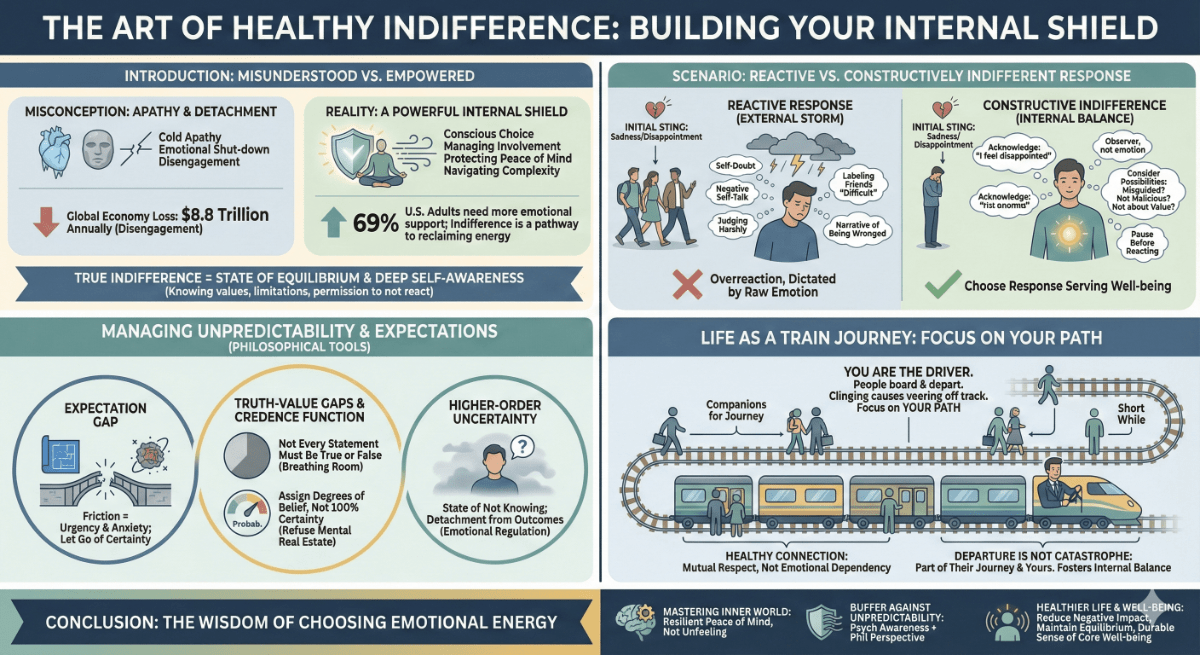
Life is like a train
You are the driver of your own train, navigating a unique path. People will board your train at various stops; some will be companions for the entire journey, while others may stay for only a short while before getting off.
This is the natural flow of life. Clinging desperately to every passenger or trying to force them to stay only causes you to veer off your own track.
The key to indifference is to remain focused on your path. This doesn’t mean building walls or refusing to connect with others. On the contrary, it’s about ensuring the connection alive in your relationships is healthy and based on mutual respect, not on emotional dependency.
When you are securely driving your own train, the departure of a passenger is not a personal catastrophe; it is simply part of their journey and yours.
This perspective fosters a deep sense of internal balance. You learn to appreciate the company you have without being shattered by its absence. You follow your own course with a steady hand, unswayed by the turbulence of arrivals and departures.
This is the essence of becoming an indifferent, and thus a happier and more balanced human being. It is the ultimate expression of self-possession and inner freedom.
Conclusion
Learning how to be indifferent is not a journey toward becoming unfeeling or uncaring. It is a sophisticated, proactive process of mastering your inner world to achieve a resilient peace of mind.
By differentiating this skill from apathy, we unlock its true potential: to serve as a buffer against the unpredictability of life and the actions of others.
We’ve seen that this involves a powerful blend of psychological awareness and philosophical perspective. It requires understanding your own mental landscape, managing your strong feelings before they escalate, and using principles like credence function and embracing higher-order uncertainty to detach from outcomes.
Whether navigating interactions with difficult people or accepting the natural ebb and flow of relationships, constructive indifference allows you to remain the calm, steady driver of your own life.
The ultimate benefit is a healthier life – one marked not by the absence of emotion, but by the wisdom to choose which emotions deserve your energy.
By practising these principles, you can reduce the impact of negative emotion, maintain your equilibrium in the face of chaos, and cultivate a durable sense of well-being that emanates from your core.