
A sense of confidence is the bedrock upon which we build our careers, our social lives, and our personal achievements. Yet, when it comes to our most intimate connections, that same confidence can feel elusive.
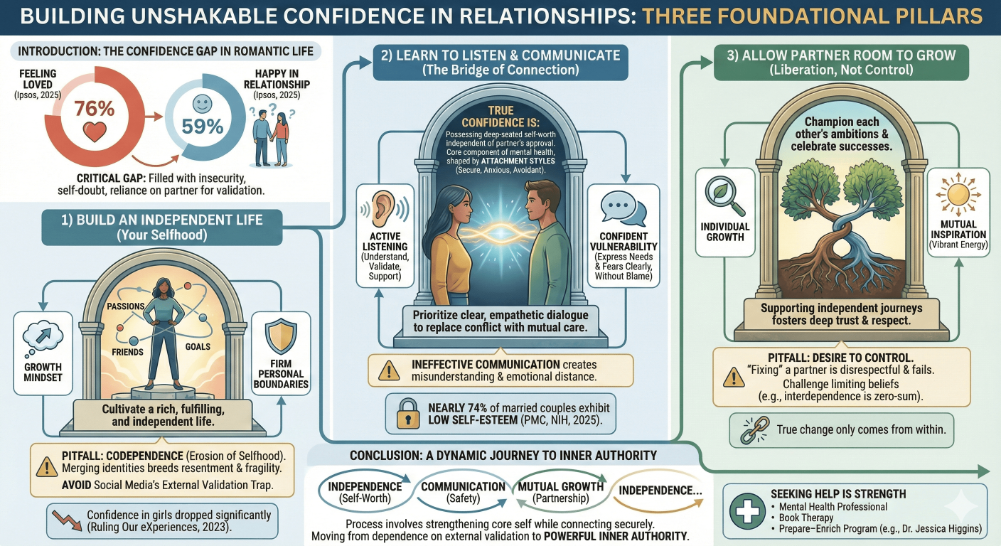
While a global survey shows that 76% of people report feeling loved, a smaller 59% are actually happy with their romantic lives, suggesting a critical gap between being in a relationship and thriving within one (Ipsos, 2025). This gap is often filled with insecurity, self-doubt, and a reliance on a partner for validation.
To be truly confident in a relationship is not about arrogance or never feeling vulnerable; it’s about possessing a deep-seated sense of self-worth that is independent of your partner’s approval.
It’s a core component of your overall mental health, influencing relationship dynamics in profound ways. This confidence is often shaped by our foundational attachment styles, the emotional blueprints we develop in childhood that dictate how we connect with others.
Those with secure attachment tend to find confidence more naturally, while those with anxious or avoidant styles may constantly battle a fear of abandonment or an over-reliance on external validation.
This article will explore three foundational pillars for building unshakable self-confidence that not only enhance your own life but also transform the quality and resilience of your partnership.
By focusing on your independence, communication, and mutual growth, you can cultivate a deep, authentic confidence that lasts.
1) Build an independent life for yourself outside of your relationships
One of the most common pitfalls in modern relationships is the erosion of selfhood, where one or both partners merge their identities to the point that their individual lives cease to exist. This often stems from a deep-seated insecurity and a belief that total investment in the partnership is the only way to secure it.
However, this dynamic creates an unhealthy codependence, breeding resentment and fragility. The most powerful way to build confidence is to cultivate a rich, fulfilling, and independent life that complements, rather than being consumed by, your relationship.
This independence is the antidote to neediness and the fear of abandonment. When you have your own passions, friendships, and goals, you develop a stronger self-concept clarity – a clear and stable understanding of who you are. This is the source of true inner authority.
You’re not looking to your partner to define you or fill a void; you are already whole. This journey starts by quieting your inner critic and cultivating a growth mindset, viewing every experience as an opportunity for personal growth.
A crucial element of this is establishing firm personal boundaries. These are not walls to keep your partner out, but guidelines that protect your well-being and self-respect. They communicate that you value yourself, your time, and your energy.
In a world dominated by social media, where lives are curated for public approval, having a strong internal compass is more important than ever. The constant pressure for external validation online can be corrosive to self-esteem.
A survey highlighted this growing issue, showing that the percentage of girls reporting confidence has dropped significantly in recent years (Ruling Our eXperiences, 2023). By building a life grounded in real-world achievements and connections, you reclaim your self-worth from the whims of others.
2) Learn to listen and communicate
Communication is the lifeblood of any healthy relationship, yet it is often the first area to break down under the weight of insecurity. Ineffective communication, or a complete lack thereof, creates a breeding ground for misunderstanding, frustration, and emotional distance.
A startling study found that nearly 74% of married couples exhibited low self-esteem, a condition that is both a cause and a consequence of poor communication patterns (PMC, NIH, 2025). To build confidence within your relationship, you must treat communication as a set of competencies to be mastered.
The cornerstone of confident communication is active listening. This is more than simply waiting for your turn to speak; it’s a practice of offering your full attention to understand your partner’s perspective, validating their feelings, and providing genuine emotional support. When your partner feels truly heard, they feel respected and valued, which builds a foundation of emotional safety.
Confident communication also requires the courage to be vulnerable. It means expressing your needs, fears, and boundaries clearly and respectfully, without blame or accusation. This practice is fueled by positive words and verbal reassurance, which act as a powerful balm for insecurity.
While it’s helpful to be aware of general differences in communication styles, such as those explored in the psychology of the sexes, the goal is not to fall back on stereotypes.
Rather, it’s to develop a unique communication method that works for your specific partnership, one that fosters mutual understanding and connection. By prioritising clear, empathetic dialogue, you replace cycles of conflict and hurt with patterns of mutual care and support.
3) Allow your partner room to grow
A common insecurity-driven impulse in relationships is the desire to control or “fix” a partner, moulding them into an idealised version that makes us feel more secure. This approach is not only disrespectful but is also doomed to fail. True and lasting change comes only from within.
A relationship built on a foundation of confidence does not seek to constrain but to liberate. It creates an environment where both individuals are encouraged to pursue their own personal growth.
Confident partners champion each other’s ambitions and celebrate their individual successes. They understand that a partner’s independent growth is not a threat to the relationship but a contribution to it.
When your partner thrives, they bring that vibrant, positive energy back into the partnership, creating a dynamic of mutual inspiration. This cultivates a powerful, self-assured energy within the relationship, where both people feel secure in themselves and in their connection.
This dynamic requires challenging the limiting beliefs that suggest interdependence is a zero-sum game. The belief that “if my partner focuses on their career, they are focusing less on me” is a product of insecurity.
In reality, supporting each other’s journeys fosters a deep sense of trust and respect, initiating a positive cycle. When you feel secure enough to give your partner space to evolve, you demonstrate a profound level of trust that strengthens your bond.
Being genuinely confident in a relationship means you are happy for your partner’s growth because your self-worth isn’t tied to their constant attention or a static version of who they are.
Conclusion
Building self-confidence in a relationship is a dynamic process that involves strengthening your core sense of self while simultaneously learning to connect with your partner in a healthier, more secure way.
It is a journey away from dependence on external validation and towards a powerful inner authority. The three pillars – building an independent life, mastering communication, and allowing room for mutual growth are interconnected and mutually reinforcing.
An independent life gives you the self-worth and resilience to engage in open, honest communication. That communication, grounded in active listening and emotional support, creates the safety needed for both you and your partner to pursue personal growth without fear.
This, in turn, fosters a partnership of two whole individuals who choose to be together not out of need, but out of a shared desire to enhance each other’s lives.
If you find yourself struggling with deep-seated insecurities or persistent negative cycles, remember that seeking help is a sign of strength.
A mental health professional can provide invaluable guidance, and resources like Book Therapy or assessments such as the Prepare–Enrich program, championed by experts like Dr. Jessica Higgins, can offer structured pathways to a healthier relationship dynamic.
Ultimately, the work you do to build your own confidence is the greatest gift you can give to yourself and your partnership.